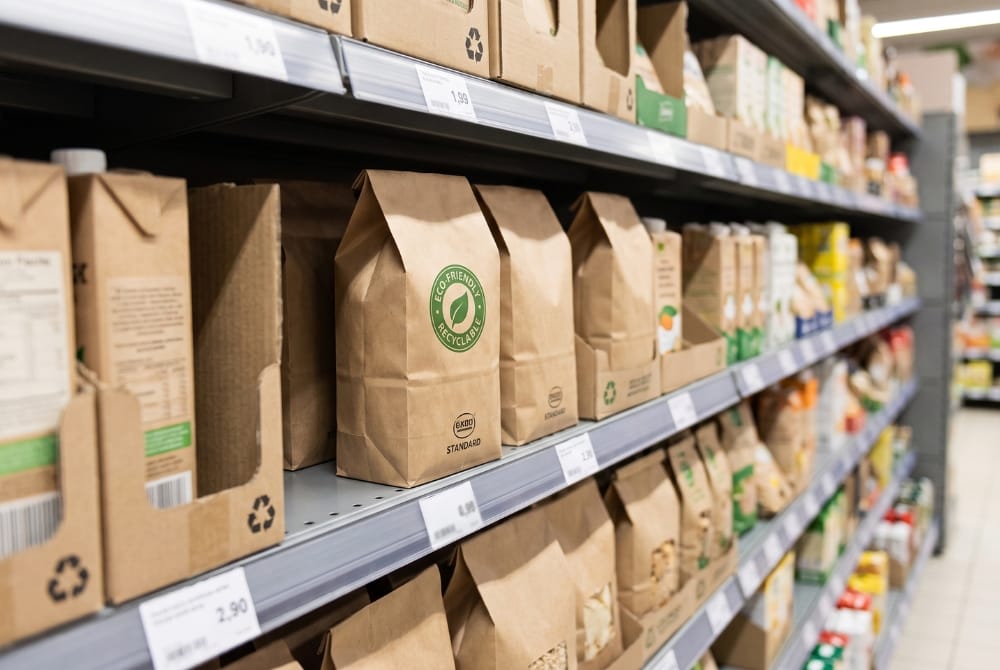
Consumers increasingly spot eco-friendly labels on supermarket shelves, but a new survey suggests widespread confusion is causing shoppers to doubt the authenticity of these sustainability claims.
A recent US study led by packaging manufacturer Alpla found that 84% of adults noticed green marketing on products over the past six months, but more than half of those (53%) are frequently unsure about what these environmental claims actually mean.
As reducing environmental impact becomes a primary goal for retailers, these findings are the latest to expose a widening gap between corporate marketing campaigns and everyday consumer understanding, on both sides of the Atlantic.
Lost trust and lost sales
Unclear labelling is not merely causing confusion; it is actively costing brands at the till. Alpla’s survey of 1,000 US adults discovered that 33% of consumers have abandoned purchases because eco-claims felt vague or unbelievable.
This scepticism is significantly more prominent among younger shoppers. Over half (51%) of Gen Z consumers reported feeling regularly baffled by green labels, compared to just 16% of Baby Boomers.
Overall, 44% of participants believe sustainability claims act primarily as marketing ploys rather than offering genuinely helpful guidance, whilst 16% said feeling misled by a product’s eco-label prompted them to lose trust in that brand.
The results of Alpla’s survey mirror recent findings from closer to home. A March 2026 study by iKrafts found that more than 85% of UK consumers surveyed approach eco-friendly packaging messages with a degree of doubt.
More than one in four (26%) believe sustainability claims are exaggerated, whilst over one in five (22%) say they’ve been misled by a brand’s claims at least once.
A demand for clear labelling
The packaging sector faces a clear requirement to improve consumer communication. Common phrases are consistently misunderstood.
A 2026 study by Instaprint found that almost seven in 10 consumers (69%) incorrectly assumed recyclable packaging always gets recycled, whereas the end of that product’s lifecycle will depend on a number of factors, including local infrastructure, collection systems, sorting facilities and consumer behaviour.
Similarly, 28% of shoppers surveyed by Alpla wrongly assumed that “made with recycled content” means the whole packet is recycled, whilst 51% mistake “recyclable” for a guarantee of local collection.
To close this knowledge gap and benefit from the rising demand for sustainable goods, companies must prioritise straightforward language alongside specific recycling instructions. Nearly 60% of people noted that clear, understandable claims heavily improve their overall view of a brand.
Industry takeaway for UK retailers
To help shops maintain consumer trust and navigate complex labelling rules, some UK wholesale suppliers are taking action.
UK manufacturer Polybags has been leading the way on this issue for a number of years, having labelled its entire catalogue with packaging standards and features to inform customers about the products they wish to buy..
This means that every product in Polybags’ extensive range of eco packaging is marked up to inform the customer of the product’s green credentials, such as whether it is recyclable or compostable.
When a product contains recycled material it is labelled accordingly: ‘100%’ if made entirely from recycled material, or ‘30%’ if it reaches that benchmark – the level at which a polythene product becomes exempt from the Plastic Packaging Tax (PPT).
Each catalogue label leads to an information page with details on what the label means, how products should be disposed of, and a handy comparison tool for how products carrying the label compare to other products on a variety of environmental factors, such as its carbon footprint, litter impact, reusability, recyclability and composability.
Polybags’ online catalogue allows customers to make informed decisions based on the content of the packaging, whilst it also allows B2B customers to pass on this important information to their own customers.
At a time when consumers are bombarded by sustainability claims from all angles, bridging this knowledge gap is key for consumers who often want to do the right thing when it comes to their packaging choices, but find it difficult to know what that actually means.